It is with a heavy heart that we have come to the end of this beautiful composition on olympus digital camera. Please do disburse its beauty to others.
Today's olympus digital camera Article
Recommended olympus digital camera Items
7th # Disaster
How to Make a Telescope ( Second English Edition)
How to Make a Telescope ( Second English Edition)
# Untitled Second

# Untitled Second
2004 reissue for one of the most innovative & challenging yet successful artists in Creation Records' 'middle period' which included Spacemen 3, My Bloody Valentine, Spectrum, & Spiritualised. This reissue is augmented with two bonus tracks, 'Tornado Mix' & 'And' (Moon Mix) by MooN, leading lights of the French Burning Emptiness label (as featured in this month's Wire magazine). Rev-Ola. 2004.
The Telescope in the Parlor: Essays on Life and Literature

The Telescope in the Parlor: Essays on Life and Literature
Celestron NexStar 5 SE Telescope

Celestron NexStar 5 SE Telescope
Celestron's NexStar 5 SE computerized telescope combines excellent optics and easy computerized GoTo tracking in a convenient portable size. The standard equipment tripod and mount feature easy no-tool setup, and the package even includes a student version of "The Sky" planetarium software for your computer.
The excellent optics of Celestron's classic C5 Schmidt-Cassegrain telescope have been updated with premium Starbright XLT optical coatings. This telescope consistently delivers crisp, high contrast views of the moon, the planets, and brighter deep space objects. The standard equipment 25mm plossl eyepiece produces a magnification of 50x, powerful enough to show the rings of Saturn, the cloud bands of Jupiter, and the changing face of the Lunar disk. Optional eyepieces can be added to bring out significantly more detail. I like to use a 12.5mm plossl (100x magnification) or a 7.5mm Ultrascopic eyepiece (166x) for high power views of the planets. With the 7.5mm Ultrascopic eyepiece I can usually see the Cassini Division in Saturn's rings and cloud bands on the planet itself. I like to use a 32mm plossl eyepiece for great low power views of deep space highlights like the Orion Nebula or the Double Cluster in Perseus.
The NexStar 5 SE package also includes a sturdy adjustable tripod, a motorized alt-azimuth mount, and the NexStar hand held computer controller. You won't need a GPS receiver or star charts to operate this telescope. The SkyAlign procedure is easy to use, and experienced observers will like the two-star align and solar-system align options because they are even quicker to set up. The steel tripod and alt-azimuth mount provide a solid base for the NexStar 5 SE. Vibration is not a problem, even while focusing at high power. The computerized tracking is also very good, easily keeping planets in the field of a high power eyepiece. The disadvantage of a computerized telescope, of course, is battery consumption. I like to use a rechargeable Celestron Power Tank because the standard AA alkaline batteries only last a few hours.
This telescope is perfect for visual observing, and allowed me to capture some sweet images of the moon and planets using a Celestron NexImage web-cam. For long exposure deep space photography, however, I'd take a look at Celestron's Advanced Series equatorial telescopes such as the C6 N-GT --Jeff Phillips
Pros:
- Excellent optics
- Light and portable
- Computerized GoTo tracking
- Short battery life
- Too light for deep space photography
Celestron Radial Guider Schmidt-Cassegrains
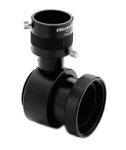
Celestron Radial Guider Schmidt-Cassegrains
Specifically for use in prime focus, deep-sky imaging or astrophotography with Schmidt-Cassegrain telescopes, the Radial Guider is compact and sleek in design. This accessory makes it possible to simultaneously photograph and guide through the optical tube assembly of your telescope. The Radial Guider also eliminates the problem of differential flexure, because you're both guiding and photographing through the telescope. The Radial Guider is compatible with Celestron's C5, C8, C9¼, C11 and C14 telescopes and comes with a unique prism angle adjustment screw. It must be used with a guiding eyepiece, camera T-Ring and drive corrector (dual axis preferred). Primarily for use with catadioptric telescopes, but also works on refractor telescopes having adequate back focus. This guider is a tremendous improvement over conventional off-axis guilders. Not only is the angle of the prism tunable, but it also maintains a fixed rigid camera orientation while still offering users the freedom to move the guiding eyepiece radially about 135°.
Unusual Telescopes

Unusual Telescopes
In this book, Peter Manly surveys more than 150 unusual telescope designs. These are telescopes built by amateur and professional astronomers to suit some special need. There is, for instance, an inflatable telescope and one with a liquid mirror. Every so often a neglected design comes back into fashion: the largest telescopes now under construction use the alt-azimuth design that was ignored for over a century, and liquid mirror telescopes can be used for zenithal astronomy. The author shows why a particular engineering approach makes each telescope unique and explains the rationale behind the design. The effects on telescope performance are discussed where possible. This is not just a collection of weird and wonderful devices that proved to be false starts; the author also discusses the first instrument to measure star diameters and the first useful radio telescope. This book is a resource and stimulus for anyone who likes to build astronomical telescopes or is interested in the history of telescope-making.
News about olympus digital camera
New Cameras Guarantee A Smile on Your Face (WallStreet Journal via Yahoo! Finance)
Wed, 23 Apr 2008 02:35:01 GMT
Most people forget their digital cameras have a settings dial that can be adjusted to take pictures in specific circumstances, or don't know how to use them. Three new digital cameras claim to do the thinking for you, but how are the results?


posted by John Ramsey @ 7:04 AM
0 comments


0 Comments:
Post a Comment
<< Home