A astronomy com Artilce for Your ViewingFinding the Telescope that Meets Your Needs
There are so many choices of telescopes out there. What do you buy and what Best Digital Camera do you really need? Here are a few things Slr Camera to keep in mind so you don't Telescope Review buy a telescope that won't meet Web Camera what you need or want it to do.
High Beach Camera power Radio Astronomy magnification is not always the primary consideration. You should have 40-60x magnification per 1 inch of aperture. The scope's ability to enlarge an image is dependent upon the lenses used Telescope Sale and the focal length within the scope itself. Most objects can be seen at the lowest magnification because there is more light being Nikon Camera focused.
The most important feature to think about when buying a telescope is aperture. Buy as much as you can afford. Remember, though, the biggest telescope is not always the best one. The aperture sizes that follow are usually sufficient: Refractors � 3 inches or 80 mm, Reflectors � 4 to 8 inches or 10 to 20mm, and Compound Telescopes � 6 to 8 inches or 16 to 20 cm.
A focuser can move the eyepiece up and down helping to adjust the focus for each observer Mead Telescope. There are two types of focusers � Friction Focusers and Rack and Pinion Focusers. Your telescope sould never shake once while you are using these. In some telescopes, you manot get a choice.
Check out the eyepieces that come with your telescope. Some don't come with any. Make sure you have a couple so you can vary the magnification of the object you are viewing. You also need to be sure that the eyepiece will fit the eyepiece holder in your telescope as not all fit all telescopes.
The type of mount you use is extremely important. Ensure it has a low center of gravity so it doesn't tip over. It should not vibrate and it should be held in place at a comfortable height for you.
astronomy com Products we recommendYoung Architects Brick-and-Mortar Statue of Liberty

Young Architects Brick-and-Mortar Statue of Liberty
Manufacturer: EDUCATIONAL INSIGHTS Grade: 3rd - 8th 'Grades 3 and up. Calling all amateur architects! Experience the fun, excitement, and pride of building your own ready-to-display stone replicas of world famous architectural masterpiecesÑbrick by brick! Mix the special mortar in the mini-sized wheelbarrow, then follow the step-by-step instructions for building each spectacular structure with real kiln-fired bricks! The special mortar dissolves in water, allowing students to create and build more structures of their own design, and teachers to use the kits year after year! Includes hundreds of real-stone bricks, base with label, bags of special water-soluble mortar mix, a wheelbarrow for mixing mortar, a masonÕs tool, an L-shaped ruler, and an 8-page illustrated instruction guide.'' allow creation of additional teacher created lessons and a permanent record of student progress - Reading and writing skills develop in a variety of ways, this program enables students to link visible letters with the sounds they hear.
Out of Sight: Pictures of Hidden Worlds

Out of Sight: Pictures of Hidden Worlds
Petzl Lens Filter Kit for Tikkina, Tikka, Zipka, Tikka Plus, Zipka Plus, Red, Green, Transparent #E44850

Petzl Lens Filter Kit for Tikkina, Tikka, Zipka, Tikka Plus, Zipka Plus, Red, Green, Transparent #E44850
State of the Universe 2008: Images, Discoveries, and Events (Springer Praxis Books / Popular Astronomy)

State of the Universe 2008: Images, Discoveries, and Events (Springer Praxis Books / Popular Astronomy)
The aim of the State of the Universe annuals is to provide an annual astronomy review suitable for the popular science level reader to be published every September in a format that will be suitable for, and appeal to, the Christmas market. The book will cover all major astronomical news on topics beyond the Solar System and place them in the context of the longer term goals of astronomers and astrophysicists around the world. The aim is to capture the excitement and vibrancy of modern astronomical research. This section also includes web links for all major news stories, providing a bridge between the public news stories and the actual research web sites.
Chapter 1 A Year in News and Pictures, written by Martin Ratcliffe, appears every year and makes up the first half of the annual. It will present brief summaries of the major announcements, discoveries and news items from that year, with the major ones being explained in detail through later chapters written by invited contributors who are at the forefront of research in these fields. The January meeting of the American Astronomical Society each year will be the major source of astronomical news for the following years volume, giving access to potential authors and contacts with public information officers of major observatories, space centers, etc.
The invited contributions which make up the second half of the annual each year will cover a variety of topics and are written to appeal to a wide readership. These are written by leading astronomers or science writers. One feature introduced in the first volume, the overall review of the State of the Universe by Dr Jim Kaler will be retained for State of the Universe 2008. The set of appendices at the end of the book will include a list of launches of major astronomical observatories/satellites during the past year; a list of planned future astronomical satellites; basic data on all astronomical observatories currently in operation with web links for the reader who wishes to find out more.
TUBE TELESCOPE 31 6 id BLUE Carton of 9

TUBE TELESCOPE 31 6 id BLUE Carton of 9
An economical storage or mailing container for drawings, tracings, maps, charts, blueprints, negatives, sensitized paper, etc. Strong jute fiber stock, tight slip caps, reinforced metal ends. Features 6in inside diameter. Outer color is an indigo paper wrap. Packaged 9/box
Celestron Polarizing Filter Set 1.25"
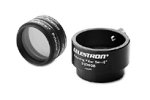
Celestron Polarizing Filter Set 1.25"
Ambient daylight is normally comprised of multiple wavelengths of light, vibrating in multiple planes. The Eyepiece Polarizing Filter Set transmits only light moving along a specific plane, thereby increasing the contrast between surfaces with different planar transmissions. Generally, the polarization effect makes blue skies a deeper blue, eliminates surface reflections and helps reduce atmospheric haze.The Polarizing Filter Set is intended for visual use. It's particularly useful for reducing glare while observing the moon, double stars, the planets and terrestrial subjects - all without affecting the color of the object being observed. The Filter Set is comprised of two filters that thread into either the eyepiece or the filter adapter, which comes with the set. When one filter is used alone, you get 30% light transmission. When both filters are used together, you can vary the degree of transmission. By causing the amount of transmitted light to vary, the filters become, in effect, a continuously variable neutral density filter. At maximum density, the Polarizing Filter Set transmits only 5% of entering light.
Celestron C150-HD Telescope

Celestron C150-HD Telescope
The C6-N uses a diffraction-limited parabolic primary mirrors for razor sharp star images across a wide field of view. The optics of this heavy-duty telescope are manufactured to Celestron's uncompromising standards with star images that are classic textbook Airy disks The C6-N is mounted on the CG-4 mount. The mount features precision gears for extremely smooth motion. A counterweight, latitude scale, setting circles, and slow motion controls on both axes are standard, so you have a fully loaded telescope right from the start.
astronomy com in the newsNew Stellar Neighbours FoundWed, 15 Nov 2006 07:36:43 GMT
Nearby binary red dwarf. Image credit: Zina Deretsky/NSF Click to enlarge Astronomers have turned up 20 new star systems in our corner of the Milky Way. The discoveries were made
…


